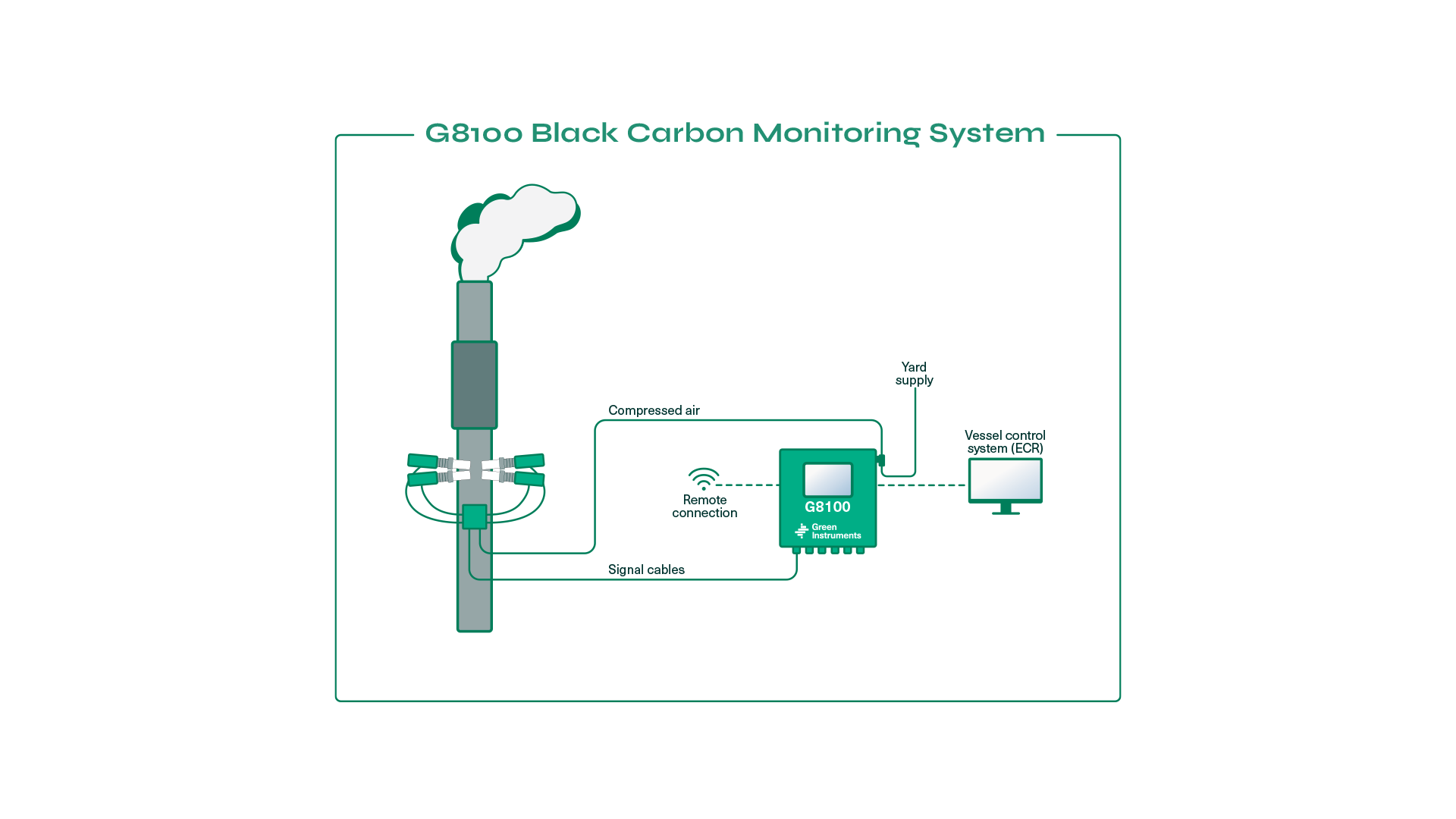
Black Carbon Monitoring System
Setting a new standard for continuous, real-time measurement of black carbon emissions in maritime environments
Product information
Black Carbon Monitoring System
Introducing state-of-the-art exhaust emissions monitoring with this advanced black carbon analyzer.
Engineered with revolutionary in situ-technology, it delivers accurate, continuous measurement of black carbon concentrations in real time. Purpose-built for the demanding conditions of maritime operations, the system ensures reliable performance at sea while supporting compliance, efficiency, and environmental stewardship.
This advanced Black Carbon Monitoring System sets a new standard for continuous, real-time measurement of black carbon emissions in maritime environments. Powered by revolutionary in situ-EMS (Extinction Minus Scattering) technology, the instrument provides highly accurate data directly within the exhaust stream, eliminating delays, improving reliability, and ensuring truly representative measurements under all operating conditions. The instrument can calculate the mass concentration using the black carbon absorption properties and automatically converts the data to the recognized standard FSN (Filter Smoke Number).
Black carbon documentation supports compliance and transparency in delicate regions such as Arctic waters or densely populated coastal areas. By monitoring black carbon trends, operators can also detect early signs of combustion inefficiency, helping to protect critical exhaust equipment including exhaust gas boilers and carbon-capture systems from degradation caused by excessive soot exposure.
Key features
- Continuous measurement of black carbon
- Revolutionary in situ-technology
- Designed explicitly for maritime applications

Data-driven insights to optimize fuel performance and sustainability
The Black Carbon Monitoring System empowers data-driven decision-making by revealing the true black carbon emission profiles of various fuels, such as LNG or emerging polar-grade fuels. With accurate, verifiable data operators can enhance ESG reporting, evaluate fuel performance, and strengthen their decarbonization strategies.